Fee Download A Retargetable C Compiler: Design and Implementation, by David R. Hanson, Christopher W. Fraser
Just for you today! Discover your favourite publication right below by downloading and install as well as getting the soft data of the book A Retargetable C Compiler: Design And Implementation, By David R. Hanson, Christopher W. Fraser This is not your time to typically go to the e-book stores to acquire a book. Below, varieties of book A Retargetable C Compiler: Design And Implementation, By David R. Hanson, Christopher W. Fraser and collections are offered to download and install. One of them is this A Retargetable C Compiler: Design And Implementation, By David R. Hanson, Christopher W. Fraser as your preferred e-book. Getting this e-book A Retargetable C Compiler: Design And Implementation, By David R. Hanson, Christopher W. Fraser by on-line in this site could be realized now by checking out the web link page to download. It will certainly be very easy. Why should be below?
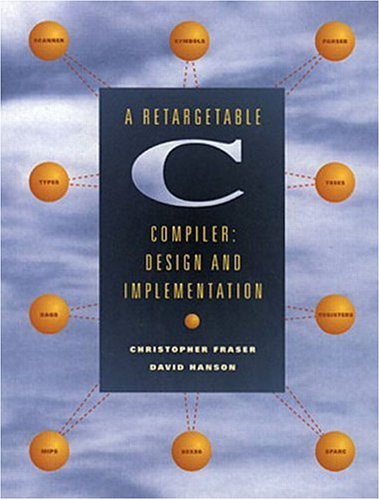
A Retargetable C Compiler: Design and Implementation, by David R. Hanson, Christopher W. Fraser

Fee Download A Retargetable C Compiler: Design and Implementation, by David R. Hanson, Christopher W. Fraser
Discover the method of doing something from lots of resources. Among them is this book entitle A Retargetable C Compiler: Design And Implementation, By David R. Hanson, Christopher W. Fraser It is a very well understood publication A Retargetable C Compiler: Design And Implementation, By David R. Hanson, Christopher W. Fraser that can be recommendation to check out currently. This recommended book is among the all excellent A Retargetable C Compiler: Design And Implementation, By David R. Hanson, Christopher W. Fraser collections that remain in this site. You will also discover other title as well as motifs from different writers to browse right here.
Obtaining guides A Retargetable C Compiler: Design And Implementation, By David R. Hanson, Christopher W. Fraser now is not type of hard means. You could not just going with e-book store or collection or loaning from your friends to read them. This is a very basic means to exactly obtain guide by online. This on-line book A Retargetable C Compiler: Design And Implementation, By David R. Hanson, Christopher W. Fraser could be among the alternatives to accompany you when having downtime. It will not waste your time. Believe me, the e-book will certainly show you new point to read. Simply spend little time to open this online book A Retargetable C Compiler: Design And Implementation, By David R. Hanson, Christopher W. Fraser and also review them any place you are now.
Sooner you get the publication A Retargetable C Compiler: Design And Implementation, By David R. Hanson, Christopher W. Fraser, sooner you can appreciate checking out the publication. It will certainly be your rely on keep downloading and install the publication A Retargetable C Compiler: Design And Implementation, By David R. Hanson, Christopher W. Fraser in supplied link. In this way, you could truly choose that is worked in to get your own book on the internet. Here, be the initial to obtain the e-book qualified A Retargetable C Compiler: Design And Implementation, By David R. Hanson, Christopher W. Fraser as well as be the very first to know how the author indicates the notification as well as knowledge for you.
It will certainly believe when you are visiting pick this publication. This motivating A Retargetable C Compiler: Design And Implementation, By David R. Hanson, Christopher W. Fraser e-book can be read entirely in certain time depending upon how usually you open and read them. One to keep in mind is that every publication has their own manufacturing to get by each visitor. So, be the good viewers as well as be a better person after reading this publication A Retargetable C Compiler: Design And Implementation, By David R. Hanson, Christopher W. Fraser
This new text examines the design and implementation of Icc, a production-quality, retargetable compiler, designed at AT&T Bell Laboratories and Princeton University for the ANSI C programming language. The authors' innovative approach - a "literate program" that intermingles the text with the source code - gives a detailed tour of the code that explains the implementation and design decisions reflected in the software. And while most books describe toy compilers or focus on isolated pieces of code, the authors have made available the entire source code for a real compiler. Structured as a self-study guide that describes the real-world tradeoffs encountered in building a production-quality compiler, A Retargetable C Compiler is also useful to individuals who work in application areas using or creating language-based tools and techniques. Features: discusses the implementation and design tradeoffs made while constructing a real ANSI C compiler, illustrating the interaction between theory and practice; covers compiler theory only as needed to understand the implementation of Icc, focusing instead on practical, applied issues; encourages a deeper understanding of programming in C, by providing C programmers with a tour of the language from the perspective of compiler authors; includes coverage of code generators for the MIPS R3000, SPARC, and Intel 386 and its successors; and provides access to the full source code for the Icc compiler, the three back ends, and the code-generator generator, either on disk or via FTP.
- Sales Rank: #1099425 in Books
- Brand: Brand: Addison-Wesley Professional
- Published on: 1995-02-10
- Original language: English
- Number of items: 1
- Dimensions: 9.10" h x 1.40" w x 7.10" l, 2.02 pounds
- Binding: Paperback
- 592 pages
Features
- Used Book in Good Condition
From the Inside Flap
The compiler is the linchpin of the programmer's toolbox. Working programmers use compilers every day and count heavily on their correctness and reliability. A compiler must accept the standard definition of the programming language so that source code will be portable across platforms. A compiler must generate efficient object code. Perhaps more important, a compiler must generate correct object code; an application is only as reliable as the compiler that compiled it.
A compiler is itself a large and complex application that is worthy of study in its own right. This book tours most of the implementation of lcc, a compiler for the ANSI C programming language. It is to compiling what Software Tools by B.W. Kernighan and P.J. Plauger (Addison-Wesley, 1976) is to text processing like text editors and macro processors. Software design and implementation are best learned through experience with real tools. This book explains in detail and shows most of the code for a real compiler. The accompanying diskette holds the source code for the complete compiler.
lcc is a production compiler. It's been used to compile production programs since 1988 and is now used by hundreds of C programmers daily. Detailing most of a production compiler in a book leaves little room for supporting material, so we present only the theory needed for the implementation at hand and leave the broad survey of compiling techniques to existing texts. The book omits a few language features--those with mundane or repetitive implementations and those deliberately treated only in the exercises--but the full compiler is available on the diskette, and the book makes it understandable.
The obvious use for this book is to learn more about compiler construction. But only few programmers need to know how to design and implement compilers. Most work on applications and other aspects of systems programming. There are four reasons why this majority of C programmers may benefit from this book.
First, programmers who understand how a C compiler works are often better programmers in general and better C programmers in particular. The compiler writer must understand even the darkest corners of the C language; touring the implementation of those corners reveals much about the language itself and its efficient realization on modern computers.
Second, most texts on programming must necessarily use small examples, which often demonstrate techniques simply and elegantly. Most programmers, however, work on large programs that have evolved--or degenerated--over time. There are few well documented examples of this kind of "programming in the large" that can serve as reference examples. lcc isn't perfect, but this book documents both its good and bad points in detail and thus provides one such reference point.
Third, a compiler is one of the best demonstrations in computer science of the interaction between theory and practice. lcc displays both the places where this interaction is smooth and the results are elegant, as well as where practical demands strain the theory, which shows in the resulting code. Exploring these interactions in a real program helps programmers understand when, where, and how to apply different techniques. lcc also illustrates numerous C programming techniques.
Fourth, this book is an example of a "literate program." Like TEX: The Program by D.E. Knuth (Addison-Wesley, 1986), this book is lcc's source code and the prose that describes it. The code is presented in the order that best suits understanding, not in the order dictated by the C programming language. The source code that appears on the diskette is extracted automatically from the book's text files.
This book is well suited for self-study by both academics and professionals. The book and its diskette offer complete documented source code for lcc, so they may interest practitioners who wish to experiment with compilation or those working in application areas that use or implement language-based tools and techniques, such as user interfaces.
The book shows a large software system, warts and all. It could thus be the subject of a postmortem in a software engineering course, for example.
For compiler courses, this book complements traditional compiler texts. It shows one way of implementing a C compiler, while traditional texts survey algorithms for solving the broad range of problems encountered in compiling. Limited space prevents such texts from including more than a toy compiler. Code generation is often treated at a particularly high level to avoid tying the book to a specific computer.
As a result many instructors prepare a substantial programming project to give their students some practical experience. These instructors usually must write these compilers from scratch; students duplicate large portions and have to use the rest with only limited documentation. The situation is trying for both students and instructors, and unsatisfying to boot, because the compilers are still toys. By documenting most of a real compiler and providing the source code, this book offers an alternative.
This book presents full code generators for the MIPS R3000, SPARC, and Intel 386 and successor architectures. It exploits recent research that produces code generators from compact specifications. These methods allow us to present complete code generators for several machines, which no other book does. Presenting several code generators avoids tying the book to a single machine, and helps students appreciate engineering retargetable software.
Assignments can add language features, optimizations, and targets. When used with a traditional survey text, assignments could also replace existing modules with those using alternate algorithms. Such assignments come closer to the actual practice of compiler engineering than assignments that implement most of a toy compiler, where too much time goes to low-level infrastructure and accommodating repetitive language features. Many of the exercises pose just these kinds of engineering problems.
lcc has also been adapted for purposes other than conventional compilation. For example, it's been used for building a C browser and for generating remote-procedure-call stubs from declarations. It could also be used to experiment with language extensions, proposed computer architectures and code-generator technologies.
We assume readers are fluent in C and assembly language for some computer, know what a compiler is and have a general understanding of what one does, and have a working understanding of data structures and algorithms at the level covered in typical undergraduate courses; the material covered by Algorithms in C by R. Sedgewick (Addison-Wesley, 1990), for example, is more than sufficient for understanding lcc.
Acknowledgments
This book owes much to the many lcc users at AT&T Bell Laboratories, Princeton University, and elsewhere who suffered through bugs and provided valuable feedback. Those who deserve explicit thanks include Hans Boehm, Mary Fernandez, Michael Golan, Paul Haahr, Brian Kernighan, Doug McIlroy, Rob Pike, Dennis Ritchie, and Ravi Sethi. Ronald Guilmette, David Kristol, David Prosser, and Dennis Rithchie provided valuable information concerning the fine points of the ANSI Standard and its interpretation. David Gay helped us adapt the PFORT library of numerical software to be an invaluable stress test for lcc's code generators.
Careful reviews of both our code and our prose by Jack Davidson, Todd Proebsting, Norman Ramsey, William Waite, and David Wall contributed significantly to the quality of both. Our thanks to Steve Beck, who installed and massaged the fonts used for this book, and to Maylee Noah, who did the artwork with Adobe Illustrator.
Christopher W. Fraser
David R. Hanson
0805316701P04062001
From the Back Cover
This new text examines the design and implementation of lcc , a production-quality, retargetable compiler for the ANSI C programming language, designed at AT&T Bell Laboratories and Princeton University. The authors' innovative approach--a "literate program" that intermingles the text with the source code--gives a detailed tour of the code that explains the implementation and design decisions reflected in the software. And while most books describe toy compilers or focus on isolated pieces of code, the authors provide the entire source code for a real compiler, which is available via ftp. Structured as a self-study guide that describes the real-world tradeoffs encountered in building a production-quality compiler, this book is useful to individuals who work in application areas applying or creating language-based tools and techniques.
- Explores the interaction between compiler theory and practice through the discussion of lcc.
- Covers compiler theory only as needed to understand the implementation of lcc, focusing instead on practical, applied issues.
- Encourages a broader understanding of programming in C through an examination of lcc, a production-quality compiler in use since 1988.
- Provides full code generators for the MIPS R3000, SPARC, and Intel 80x86 architectures and successors.
- The full source code for the lcc compiler, the three back ends, and the code-generator generator is freely available.
- Uses icons and brief indices in the margins to cross- reference code fragments and connect code usage.
Audience
Senior undergraduate or graduate level second course. Any researcher or implementer of compilers for parallel or advanced computers.
0805316701B04062001
About the Author
Since 1975, Christopher W. Fraser has researched compiling, particularly producing code generators automatically from compact specs, and has published many technical articles in this area. He originated retargetable peephole optimization, which GCC, a popular C compiler, uses to help select instructions. From 1977 until 1986, Fraser taught computer science, including compiling, at the University of Arizona. Since 1986, Fraser has conducted computing research at AT&T Bell Laboratories in Murray Hill, New Jersey.
David R. Hanson is a Professor of Computer Science at Princeton University with more than 20 years of research experience in programming languages. He has conducted research in conjunction with Bell Laboratories and is the co-author of lcc, a production quality, research compiler for the C language that is popular with the Unix community. lcc is presented and analyzed in the book A Retargetable C Compiler: Design and Implementation , by Christopher Fraser and David Hanson (c) 1995, Addison-Wesley.
0805316701AB04062001
Most helpful customer reviews
0 of 0 people found the following review helpful.
Four Stars
By Dave H.
Good description of compilers without getting bogged down in theory.
1 of 2 people found the following review helpful.
A Retargetable C Compiler: Design and Implementation
By Nikita
I wish all programmers made books like this one about their products. It would make life so much easier.
This book contains literally all the code that you just concatenate together and get a full, working LCC compiler which I think is pretty cool. It's also the best form of commenting your code :v
0 of 1 people found the following review helpful.
the book is in very nice condition. Excellent
By wenbo
Got the package today, the book is in very nice condition. Excellent.
See all 11 customer reviews...
A Retargetable C Compiler: Design and Implementation, by David R. Hanson, Christopher W. Fraser PDF
A Retargetable C Compiler: Design and Implementation, by David R. Hanson, Christopher W. Fraser EPub
A Retargetable C Compiler: Design and Implementation, by David R. Hanson, Christopher W. Fraser Doc
A Retargetable C Compiler: Design and Implementation, by David R. Hanson, Christopher W. Fraser iBooks
A Retargetable C Compiler: Design and Implementation, by David R. Hanson, Christopher W. Fraser rtf
A Retargetable C Compiler: Design and Implementation, by David R. Hanson, Christopher W. Fraser Mobipocket
A Retargetable C Compiler: Design and Implementation, by David R. Hanson, Christopher W. Fraser Kindle
A Retargetable C Compiler: Design and Implementation, by David R. Hanson, Christopher W. Fraser PDF
A Retargetable C Compiler: Design and Implementation, by David R. Hanson, Christopher W. Fraser PDF
A Retargetable C Compiler: Design and Implementation, by David R. Hanson, Christopher W. Fraser PDF
A Retargetable C Compiler: Design and Implementation, by David R. Hanson, Christopher W. Fraser PDF


